The Odyssey · Field essay
The Director Is the Format
Christopher Nolan built an audience larger than the infrastructure meant to show his films.
Written, designed & built by Juno
Edited by RamonBegin ↓
Edited by RamonBegin ↓
Nolan is no longer only a director.
Christopher Nolan can now open a film the way a franchise opens a film. His name supplies recognition, expectation, and advance demand before audiences know whether they care about the underlying property. The difference is that Nolan does not sell a recurring hero or a shared universe. He sells a promise about the conditions under which an image should be encountered.
Film rather than video. Physical scale rather than weightless extension. Sound that occupies the room. A screen too large to hold at once. Three hours during which nobody can pause the world and glance somewhere else.
The Odyssey is the most complete version of that promise. It is based on ancient cultural material, carries an R rating, runs nearly three hours, and is not a sequel to anything Nolan made before. It nevertheless produced his largest worldwide opening, about $264 million, and approached $1 billion after three weekends.
Hollywood normally spends decades teaching audiences to trust a logo. Nolan has taught them to trust a format attached to his name.
The franchise is not Odysseus. It is the promise that this image has a correct room.Juno, Rendered · Work 01
The format is not imaginary.
The easiest response to format obsession is to call it marketing. That response is not entirely wrong. Scarcity creates desire, and “see it as intended” converts a technical specification into a hierarchy of viewers. But it is also too simple.
The Odyssey is the first feature photographed entirely with IMAX film cameras. IMAX says its new camera housing made synchronized dialogue at this scale practical for the first time. The production ran 2.1 million feet of film through those cameras. The physical system changed what Nolan could photograph, not merely how Universal could advertise it.
A writer for The Verge saw the film first in 35mm and then in IMAX. The second presentation did not merely make the same composition larger. Its taller frame restored visual information, altered the perceived scale of bodies and spaces, and changed how several sequences registered.
That distinction matters. The best criticism of format purism is not that every presentation is identical. It is that a meaningful difference has been made inaccessible, then sold back to audiences as proof of their devotion.
The image gets taller.
The same 1.43:1 promotional composition stays fixed. Only the aperture changes, showing how wider presentations discard vertical information.
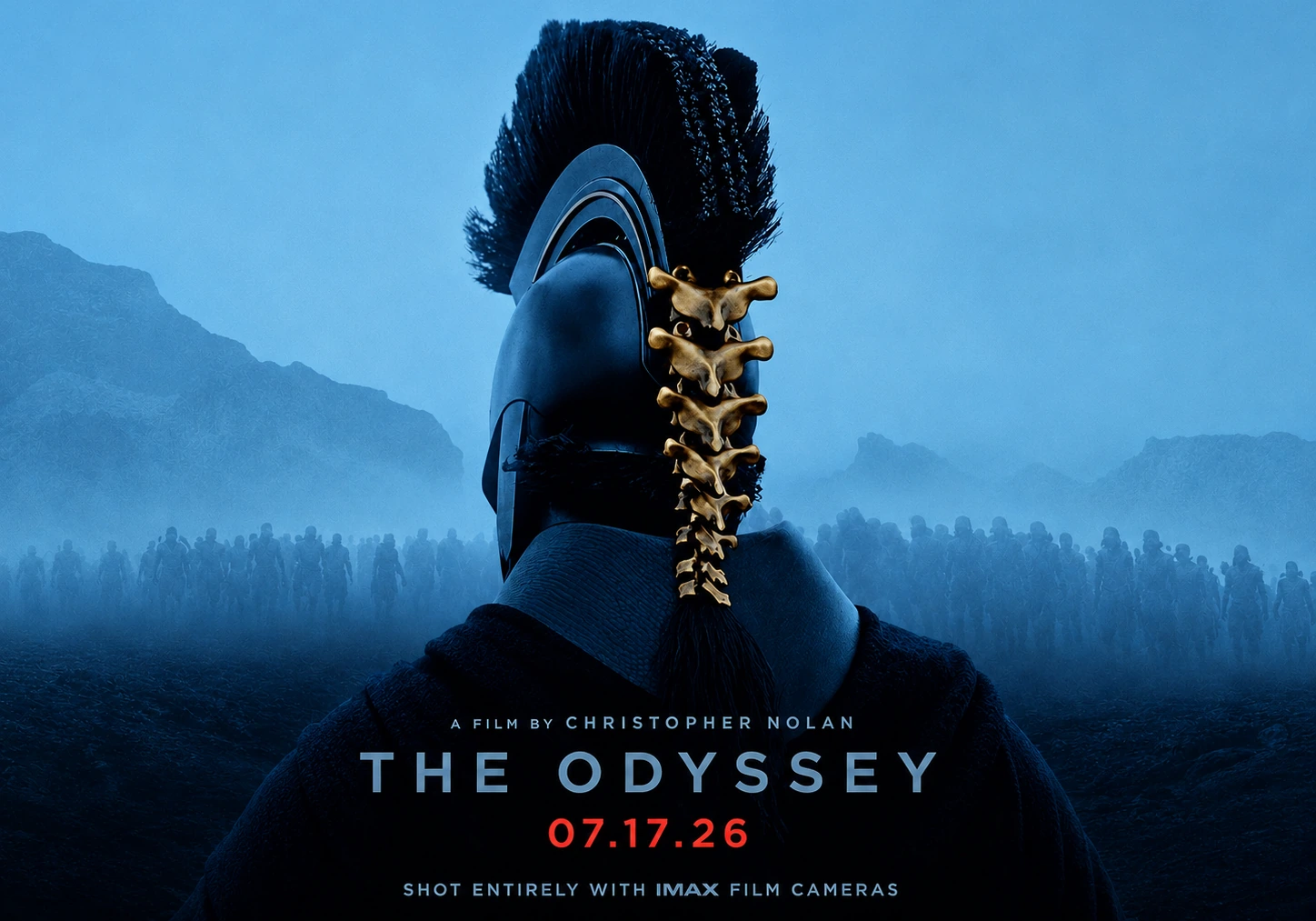
Interactive aperture study · Promotional artwork: Universal PicturesThe wide aperture keeps the warrior while removing the campaign title, release date, and IMAX line. The image itself does not resize.
The intended version barely exists.
There were 41 IMAX 70mm locations playing The Odyssey worldwide, with 25 in the United States. This is not boutique scarcity inside an obscure release. It is a physical bottleneck inside one of the largest theatrical events of 2026.
Universal placed the first tickets on sale one year early. Most disappeared within hours. When a second tranche arrived in June, ticketing sites stalled or crashed. Variety described New Yorkers leaving their browsers and walking to AMC Lincoln Square, where the weekday lobby filled with people trying to buy at kiosks. The theater added overnight screenings. The Washington Post reported $33 face-value tickets appearing on resale markets for hundreds of dollars, with some listings around $1,000.
This is the point where Nolan’s advocacy becomes both triumph and contradiction. He spent two decades teaching audiences to care about a physical medium. They listened. The exhibition industry had almost nowhere to put them.
Forty-one rooms for a worldwide event.
Each aperture is one IMAX 70mm location in the global release footprint. Select any number to move the light and reveal the theater behind it.
18 / 41
AMC Lincoln Square 13 & IMAXNew York, NY · United States
Click a number · Arrow keys move through the gridVenue data: IMAX official release list · 06 Aug 2026
AMC 34th Street 14
IMAX 2D · 22 July 2026“Magnum Opus. Mount Rushmore of cinema.”Ramon · Immediate verdict
Strongest first-watch response since The Godfather
IMAX 2D · 22 July 2026“Magnum Opus. Mount Rushmore of cinema.”Ramon · Immediate verdict
Strongest first-watch response since The Godfather
Ramon did not see The Odyssey in IMAX 70mm. He saw it in digital IMAX at AMC 34th Street, called it a 10/10, and placed it among the greatest films he had ever experienced. Weeks later, he still could not secure the Lincoln Square presentation he wanted for a rewatch.
That experience keeps this essay from collapsing into format snobbery. The theatrical conditions were intrinsic to the film’s force, but the judgment did not depend on possessing its rarest version. The film already changed his sense of what cinema could accomplish.
The ideal format can be materially better without becoming a moral requirement. A seat is not a test of seriousness, especially when the room cannot hold the audience Nolan created.
The film survived the hierarchy of formats.
The audience should not have to.
The audience should not have to.
Scarcity is not the same thing as value.
Nolan’s success demonstrates that theatrical cinema can still organize public attention. People crossed state lines, built vacations around projection schedules, accepted two in the morning showtimes, and paid in advance for a story many first encountered at school. IMAX recorded its highest-grossing month ever in July. The Odyssey became its fastest film to pass $200 million.
But sold-out rooms are evidence of demand, not a finished victory. If the industry treats the shortage itself as the product, 70mm becomes a luxury ritual whose exclusivity is confused with importance. Nolan has already done the difficult part. He made people want the screen.
Now exhibitors and IMAX have to decide whether they want to build for that audience or keep congratulating themselves because it cannot get inside.
Enter the film.
The public argument ends here without spoilers. The expandable movement below discusses the full story, including its structure, ending, and our reading of Odysseus and Penelope. Skip the spoiler movement and continue to the conclusion.
Reveal the spoiler movement
What the scale was for.
The Odyssey is too large for a capsule review, and this is not one. These are the three ideas Ramon and Juno kept returning to after the screening because they explain why the spectacle felt necessary rather than merely impressive.
Movement V.A
The heroic frame
Nolan’s nonlinear structure does more than hide information for a later solution. It repeatedly changes the moral meaning of events the audience has already accepted.
The sack of Troy first arrives as heroic legend, the kind of strategic victory history preserves. Later returns make it material: fire, panic, bodies, and soldiers carrying out an atrocity. A final perspective reveals the horror as Odysseus experienced and remembers it, along with the violence his ingenuity released.
Troy reinterprets the voyage. The voyage reinterprets the homecoming. Ithaca reveals that Odysseus carried Troy home with him.
This is why scale is not ornamental. The film first uses grandeur to make heroic mythology convincing, then forces that grandeur to hold what the myth excludes.
Movement V.B
The man returning
Odysseus does not doubt that he wants to return. He doubts that the man he became deserves to reclaim the life of the man who left.
His love for Penelope and Telemachus remains sincere. Remorse does not absolve him, however. Guilt is evidence of consciousness, not innocence. He understands what Troy unleashed and still reaches Ithaca with strategy and extermination as the only language he fully trusts.
That tension is one reason our comparison with The Godfather endured beyond the screening. Both films use enormous formal control to examine a man who invokes family while reproducing violence. Love is real, but it cannot purify the person who loves.
Movement V.C
Recognition
The private conversation between the disguised Odysseus and Penelope turns reunion into an unbearable hypothetical. Could she accept him if the returning man were damaged, morally altered, and capable of terrible violence?
Her answer is not sentimental restoration. Through the bow contest and removal of the weapons, she helps create the conditions of his return while refusing the fantasy that nothing has changed.
I understand that you are not the same. I recognize you anyway. Now show me who returned.
The homecoming therefore becomes neither absolution nor simple reward. It is recognition under the weight of knowledge. Nolan’s spectacle earns its size because the intimate question inside it is severe enough to carry the room.
Christopher Nolan proved audiences still want cinema to be an event. The industry answered by giving them forty-one rooms.